Last updated: September 2026 · Identification reviewed against Wildlife Illinois, EPA and National Park Service guidance
Pest Price Guide is independent. We do not sell pest-control or wildlife-removal services and do not accept payment from pest-control companies for favorable placement.
Scratching sounds in walls can come from rodents, squirrels, bats, birds or other wildlife, and sound alone usually cannot identify the animal with certainty. Timing can narrow the possibilities, but location and physical evidence are more useful when combined with what you hear.
For example, Wildlife Illinois associates small nighttime scratching or running sounds with mice or rats. However, the same state wildlife resource notes that squirrels, bats and raccoons can also produce noises inside buildings.
Therefore, treat the sound as the beginning of the investigation—not the final identification.
Record when you hear the noise, where it comes from, what it sounds like and what physical evidence you can find. Combining those clues is much more useful than relying on one sound.
Scratching sounds in walls: quick identification table
The table below shows possibilities worth investigating. It is not a definitive species-identification chart.
| Sound or pattern | Possible source | What to check next |
|---|---|---|
| Small scratching or running, especially at night | Mice or rats | Droppings, gnawing, nesting material, entry gaps |
| Scurrying or muffled movement overhead | Squirrels or other wildlife | Attic, soffits, roofline and exterior entry points |
| Loud thumping, scratching or vocalizations | Possible raccoon or larger animal | Attic or chimney; avoid direct contact |
| High-pitched chirps or light rustling | Possible bats | Attic/roof area and exterior activity around dusk |
| Chirping plus movement near a vent | Possible birds | Exterior vents, eaves and nesting areas |
| Gnawing or scraping with rodent evidence | Mice or rats | Food packaging, wiring, walls and entry points |
Sound descriptions are investigation clues rather than proof. Wildlife Illinois specifically notes that species identification based on sound alone can be difficult.
First question: where is the sound?
Before focusing on the clock, determine whether the noise seems to come from a wall cavity, ceiling, attic, chimney or exterior wall.
This matters because different spaces provide different access and nesting opportunities.
Inside a wall
Small rodents are an important possibility when light scratching, gnawing or scurrying seems to come from a wall cavity.
EPA lists several signs that strengthen a rodent identification: droppings, shredded nesting material, gnawed food packaging, holes through walls or floors and stale odors from concealed spaces.
Therefore, a nighttime scratching sound plus mouse-sized droppings beneath the sink provides stronger evidence than the sound by itself.
Above the ceiling or in the attic
An attic expands the list of possibilities.
Mice and rats can use attics, but squirrels, bats, birds and larger wildlife can also occupy roof-level spaces.
As a result, heavy movement overhead should not automatically be labeled a rat, while light movement should not automatically be labeled a mouse.
Inside a chimney
Wildlife Illinois lists birds, tree squirrels and raccoons among possible sources of chimney noise.
Consequently, avoid reaching into or sealing a chimney simply because the noise stops temporarily.
Second question: when do you hear it?
Timing is useful, but it should be treated as a filter rather than a verdict.
| Timing | Possibilities worth checking |
|---|---|
| Mostly at night | Mice, rats, flying squirrels or other nocturnal wildlife |
| Mostly during daylight | Day-active squirrels, birds or activity from animals/young inside a den |
| Around dusk or dawn | Consider bats or animals leaving/returning to shelter |
| At many different times | Do not eliminate a species based on timing alone |
One reason timing rules become confusing is that “squirrel” does not describe one behavior pattern. Some squirrels are active during the day, while flying squirrels are nocturnal.
Similarly, noises from young animals inside a den do not necessarily follow the adult’s normal activity schedule.
Therefore, a nighttime scurry does not prove rats, and daytime movement does not prove squirrels.
The 3-night sound log
Instead of relying on one episode, record the pattern for several nights if there is no immediate safety issue.
| Observation | Night 1 | Night 2 | Night 3 |
|---|---|---|---|
| Time | _____ | _____ | _____ |
| Duration | _____ | _____ | _____ |
| Wall/ceiling/attic | _____ | _____ | _____ |
| Scratch/scurry/gnaw/thump/chirp | _____ | _____ | _____ |
| Same location? | _____ | _____ | _____ |
| Physical evidence found | _____ | _____ | _____ |
This log will not identify the animal by itself. However, it gives you a more useful record to compare with physical evidence or provide to an inspector.
What mice and rats sound like in walls
Wildlife Illinois describes small scratching or the sound of a small animal running, particularly at night, as consistent with mice or rats.
EPA training material also notes that rats can be heard gnawing, clawing and scrambling inside walls, particularly when buildings are quiet. Mouse sounds may be harder to hear.
Still, EPA cautions that squirrels and other animals can produce similar sounds. Therefore, confirm suspected rodents with additional evidence.
Look for rodent evidence
EPA recommends looking for:
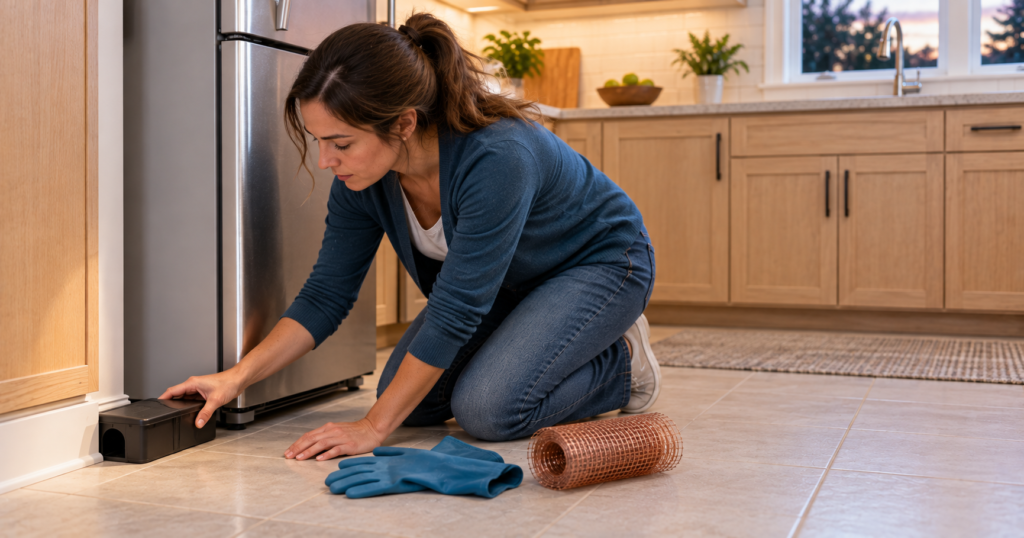
- Droppings around food packages, drawers, cupboards or beneath sinks
- Shredded paper, fabric or plant material used for nesting
- Gnawed food packaging
- Holes through walls or floors
- Stale odors from hidden areas
If you find droppings, use our mouse vs rat droppings guide to compare the evidence and clean it safely.
Can you tell mice from rats by sound?
Not reliably enough to base treatment on sound alone.
A larger animal may sound heavier, but walls, insulation, framing and distance change how noise travels through a building.
Therefore, do not assume a louder scratch proves rats.
Instead, combine the sound with droppings, gnaw marks, tracks, entry openings and other physical signs.
Low confidence: scratching sound only.
Better: repeated sound from the same area at similar times.
Stronger: sound plus droppings, gnawing or nesting material.
Strongest: physical evidence plus a sighting, camera image or professional identification.
Could the noise be squirrels?
Yes, particularly when activity involves an attic, roofline or another upper part of the structure.
However, timing requires care.
Common tree squirrels and flying squirrels do not necessarily share the same activity schedule. Therefore, generic advice stating that “squirrels are active during the day” can miss nocturnal flying squirrels.
Wildlife Illinois associates scurrying, bumps or muffled movement at night with tree squirrels in its building-noise guidance.
Consequently, location and other evidence remain important.
Look outside for roofline access, damaged soffits or other openings, but avoid sealing them until you understand what animal is using the structure.
Could the noise be a raccoon?
Loud thumping, scratching or vocalizations from an attic can justify considering raccoons or another larger animal.
Wildlife Illinois associates loud vocalizations, thumping and scratching—particularly during the day—with possible raccoon activity.
Its vocalization guidance also notes that adults may leave at night while young remain in the den. Therefore, sounds from a family group can occur at times that do not match a simple “raccoons are nocturnal” rule.
If you suspect a raccoon or other larger wildlife inside the structure, avoid direct contact and use an appropriate wildlife professional or state wildlife resource for guidance.
Could scratching sounds actually be bats?
Bats can produce light rustling and high-pitched chirps that insulation may partially muffle.
Wildlife Illinois notes that homeowners sometimes do not realize bats are present unless they see them.
Therefore, sound alone is particularly weak evidence for bats.
Observing animals exiting the building around dusk can provide more useful evidence, but do not block an opening immediately after locating it.
National Park Service guidance warns against excluding bats during periods when they are not leaving the roost regularly, including maternity season, hibernation or torpor and some periods of bad weather. Species, geography and season matter, so check state wildlife guidance before attempting exclusion.
Could birds be making the noise?
Birds can enter vents, soffits, chimneys and other structural openings.
Chirping provides a useful clue, particularly when it accompanies scratching or movement during daylight.
However, wildlife laws matter. Wildlife Illinois notes that while certain nonnative species can be removed without a permit, other birds receive federal and state protection.
Therefore, identify the bird and check applicable wildlife rules before disturbing an active nest.
What about termites or carpenter ants?
Do not assume every faint sound inside a wall comes from an animal large enough to hear running.
However, sound is a particularly poor way to identify wood-destroying insects.
If you find swarmers, discarded wings, mud tubes, damaged wood or other insect evidence, investigate those signs directly rather than trying to identify an insect infestation from wall noise.
If you are comparing swarmers, see our termite vs flying ant guide.
What physical evidence should you look for?
Once you have recorded the sound, look for evidence that can confirm or eliminate possibilities.
| Evidence | What it can tell you |
|---|---|
| Droppings | Can support rodent or wildlife identification |
| Gnaw marks | Support rodent activity when combined with other signs |
| Nesting material | Shows that an animal may be using the structure for shelter |
| Exterior openings | Shows possible access routes |
| Tracks or rub marks | Can show repeated travel routes |
| Camera image or sighting | Much stronger species evidence than sound alone |
EPA recognizes droppings, nesting material, chewing damage, entry holes and odors as signs of rodent infestation.
Nevertheless, avoid disturbing droppings during your inspection. Our rodent-droppings guide explains CDC-recommended cleanup precautions.
Should you record the sound?
A phone recording can document when and where the noise occurs, although recordings made through drywall rarely provide definitive species identification.
If you record it, note the exact room, approximate wall or ceiling location and time.
Then pair the recording with photographs of physical evidence.
This produces a more useful inspection record than sending a technician an isolated audio clip with no context.
Should you cut open the wall?
Usually, identifying an unexplained sound does not justify immediately cutting drywall.
First inspect accessible areas, look for exterior entry points and collect noninvasive evidence.
Opening a wall before locating the source can create unnecessary repair work while still failing to reveal the animal.
If the sound continues but the source remains inaccessible, an inspection may be a more practical next step.
Our free pest inspection guide explains what to ask before authorizing treatment.
Do not seal an opening just because you found it
Finding a hole is not the same as knowing it is safe to close.
Exclusion must account for the species, whether animals remain inside and whether dependent young are present.
Otherwise, closing the wrong opening at the wrong time can create a new problem.
Before closing a suspected wildlife entry point, determine what is using it and whether the animals can leave safely. This is particularly important for bats and wildlife with dependent young.
Once active animals are appropriately removed or excluded, sealing entry points becomes an important prevention step. EPA recommends sealing holes inside and outside homes as part of rodent prevention.
Why “never seal while animals are inside” needs nuance
The original advice is directionally useful, but exclusion is more complicated than simply waiting until the house becomes quiet.
Wildlife professionals can use species-specific exclusion methods that allow animals to leave without re-entering.
However, those methods are not appropriate in every season or for every species.
For bats, for example, National Park Service guidance specifically warns against exclusion during maternity periods and other times when bats are not regularly leaving the roost.
Therefore, the safer rule is: do not permanently close an active wildlife opening until you understand the species and the correct exclusion procedure.
What if the scratching suddenly stops?
Silence does not tell you exactly what happened.
The animal may have left, shifted to another part of the structure or simply become inactive when you were listening.
Therefore, do not assume that one quiet night proves the problem has resolved.
Instead, continue checking for physical evidence such as new droppings, gnawing, nesting material or exterior activity.
What if you find rodent droppings?
Do not sweep or vacuum dry rodent droppings.
Rodent waste requires wet disinfection before cleanup because contaminated material can become airborne when disturbed.
Our mouse vs rat droppings guide explains the current CDC cleanup procedure.
Finding new droppings after safe cleanup also provides stronger evidence of continuing activity than the sound alone.
What if the noise is coming from the attic?
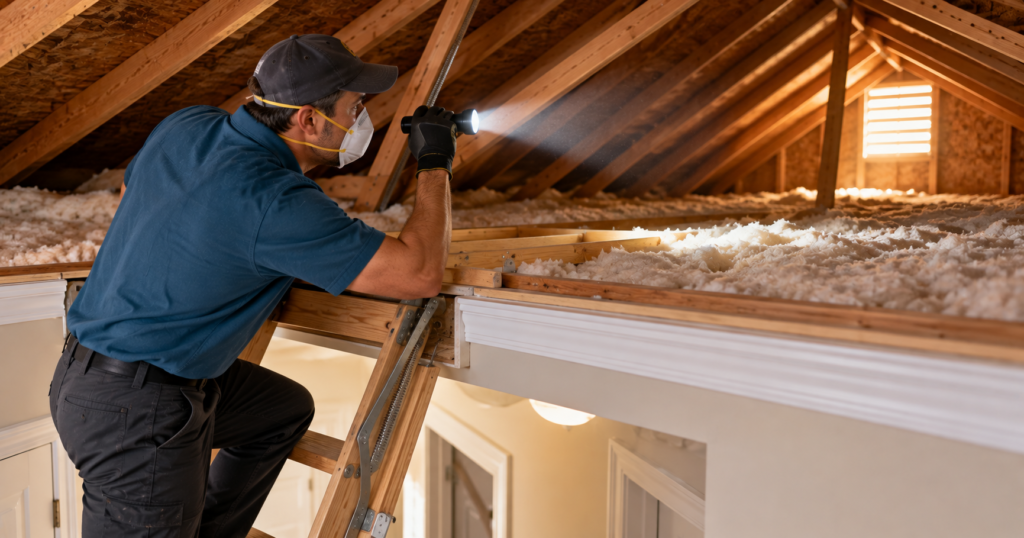
An attic inspection may reveal droppings, nesting material, damaged insulation or entry points.
However, widespread contamination can turn a simple removal job into a separate remediation project.
If insulation has been contaminated, see our attic insulation rodent damage guide for removal and replacement costs.
From noise to action: a simple decision tree
| What you find | Useful next step |
|---|---|
| Light wall noise + rodent droppings | Investigate mice/rats and locate entry points |
| Heavy attic movement | Investigate larger wildlife before sealing openings |
| Chirping/rustling + bats observed at dusk | Check state wildlife guidance and appropriate bat-exclusion timing |
| Bird calls near vent/chimney | Identify species and check nest/wildlife rules |
| Sound but no physical evidence | Keep a log and inspect before selecting treatment |
| Widespread droppings/contamination | Use appropriate cleanup precautions; consider remediation scope |
How much does removal cost?
The cost depends on what is actually making the sound and what work the property requires.
A rodent project can include inspection, trapping, follow-up visits, exclusion, cleanup and repairs. Wildlife removal can involve a different scope entirely.
Therefore, a low trapping quote and a larger exclusion-and-cleanup quote may describe different projects rather than simply different prices.
For mice and rats, see our rodent control cost guide.
For broader household pest pricing, see our pest control cost guide.
Does homeowners insurance cover the damage?
Do not assume that identifying the animal automatically determines insurance coverage.
Coverage depends on the policy language, cause of damage and circumstances of the loss.
For rodent-related losses, our homeowners insurance and rodent damage guide explains the issue in more detail.
When an inspection makes sense
An inspection becomes particularly useful when the sound continues but you cannot confirm the source.
Consider getting help when:
- You hear repeated activity but cannot access the area safely
- You suspect bats, raccoons or other wildlife
- You find widespread contamination
- You cannot identify the entry point
- The sound continues after rodent-control work
- You need to know whether exclusion can be performed safely
Before approving work, ask the inspector what evidence supports the identification and which part of the proposed service addresses removal, exclusion, cleanup or repair.
The evidence worksheet
Use this before requesting a quote.
| Observation | Your notes |
|---|---|
| First date heard | ____________ |
| Typical time | ____________ |
| Wall / ceiling / attic / chimney | ____________ |
| Scratch / scurry / gnaw / thump / chirp | ____________ |
| Droppings found | Yes / No |
| Gnaw marks found | Yes / No |
| Nesting material | Yes / No |
| Exterior opening found | Yes / No |
| Animal observed | ____________ |
| Photo/video available | Yes / No |
The goal is not to diagnose an animal from sound. Instead, this worksheet turns a vague complaint—“something is scratching in my wall”—into evidence an inspector can actually use.
Our methodology
Pest Price Guide does not perform wildlife removal and does not publish original acoustic research.
For sound identification, this guide prioritizes Wildlife Illinois, a state wildlife resource. Its guidance identifies mice, rats, bats, squirrels, opossums and raccoons as possible sources of scratching noises in buildings and specifically cautions that identifying wildlife by sound alone can be difficult.
For rodent evidence and prevention, we use EPA guidance. EPA identifies droppings, nesting material, gnawed packaging, structural openings and hidden odors as common signs of rodent infestation. It also recommends reducing food, water and shelter and sealing entry points as part of prevention.
For bats, we use National Park Service guidance because exclusion timing can affect wildlife. NPS advises against bat exclusion during maternity season, hibernation or torpor, and other periods when bats are not leaving a roost regularly.
Finally, the sound log, confidence test, decision tree and evidence worksheet are Pest Price Guide organizational tools. They are designed to help homeowners gather evidence before selecting a treatment or removal service; they are not species-identification guarantees.
Frequently asked questions
What causes scratching sounds in walls at night?
Mice and rats are important possibilities, but nighttime sound alone does not confirm rodents. Flying squirrels and other wildlife can also be active at night. Look for physical evidence.
How can I tell whether the sound is a mouse or rat?
Sound alone usually cannot distinguish them reliably. Compare droppings, gnawing, entry points and other evidence in addition to the noise.
Do squirrels make noise at night?
Some can. Activity patterns vary by squirrel species, and flying squirrels are nocturnal. Therefore, nighttime movement does not automatically eliminate squirrels.
Can raccoons make noise during the day?
Yes. Wildlife Illinois associates daytime thumping, scratching and vocalizations with possible raccoon activity, particularly when animals are denning inside a structure.
Should I seal a hole if I think an animal is using it?
Do not permanently close an active wildlife opening until you know what is using it and the appropriate exclusion procedure. Species and season matter, especially for bats and animals with dependent young.
What if the scratching suddenly stops?
Silence does not prove the problem is resolved. The animal may have left temporarily, moved elsewhere in the structure or become inactive. Continue looking for physical evidence.
Should I cut open the wall?
Usually not as a first step. Gather noninvasive evidence and inspect accessible areas before creating drywall damage. Persistent inaccessible activity may justify a professional inspection.
Are droppings more useful than sound?
They can provide much stronger evidence, especially when combined with size, location, gnawing and other signs. Handle rodent waste using appropriate CDC cleanup precautions.
Final thoughts
Scratching sounds in walls can narrow the investigation, but they rarely identify an animal by themselves.
Start with location. Then record timing and sound type. Finally, look for physical evidence such as droppings, gnawing, nesting material and entry points.
Small nighttime sounds plus rodent evidence strengthen the case for mice or rats. Heavy attic activity broadens the investigation to larger wildlife. Chirping or light rustling near the roofline can justify checking for bats or birds.
Most importantly, do not rush from hearing a noise to sealing an opening. First identify what is using the structure and determine the appropriate exclusion method and timing.
A three-night log, a few photographs and a careful inspection can provide far more useful information than trying to identify an animal from one scratch behind the drywall.