Last updated: September 2026 · A guide to rats in the attic built from UC Statewide IPM guidance and published removal pricing
Pest Price Guide is independent. We sell no treatment and take no referral fee from any company. Figures below are published ranges, not quotes for your property.
Rats in the attic are almost always roof rats, and getting rid of them usually costs more than the trapping quote suggests. Removal itself often runs a few hundred dollars, but a complete job also includes sealing the roofline and, if the rats have been there a while, cleaning or replacing contaminated insulation. That full scope is what decides the bill.
Species matters because it tells you where they got in. The University of California’s Statewide IPM Program describes roof rats as agile climbers that nest above ground in trees, shrubs and dense vegetation, and indoors in attics, wall voids, ceiling voids and cabinets. Norway rats, by contrast, burrow along foundations and stay low. Rats overhead usually got in from above, via branches, vines or utility lines.
This guide covers how to confirm them, why they are a genuine safety issue, what removal costs component by component, and the order of work that keeps them from coming back.
Signs of rats in the attic
- Noises at night. Scurrying, scratching and gnawing overhead after dark, often along the edges of the ceiling.
- Droppings. Larger than mouse droppings, with blunt ends, along beams, on insulation and near entry points.
- Tunnels and nests in insulation. Flattened runways or shredded nesting material.
- Gnawed wires, wood or ductwork.
- Grease marks where fur rubs along rafters, pipes and entry holes.
- Odor. A musty or ammonia smell from urine in the insulation.
Our mouse vs rat droppings guide helps confirm whether you have rats or mice, and our guide to scratching sounds in walls explains how rodent noise differs from squirrels and other wildlife. Squirrels are usually active in daylight, while rats are active at night.
Do not stir up the attic Rodent droppings and urine-soaked insulation can carry pathogens. Avoid sweeping, vacuuming or crawling through contaminated insulation without protection, and follow CDC cleanup guidance for any small area you handle yourself.
Roof rats vs Norway rats in the attic
Roof rats
- Smaller and sleeker, tail longer than head and body
- Agile climbers
- Nest in attics, wall and ceiling voids
- Enter from branches, vines, utility lines and roof gaps
Norway rats
- Larger and stockier, shorter tail
- Burrowers
- Nest along foundations, under woodpiles and slabs
- Usually found at ground level, basements and crawl spaces
Characteristics from UC Statewide IPM.
UC IPM stresses that knowing which species you have matters for choosing effective control. When both occur in one building, published summaries of UC IPM guidance note that Norway rats tend to occupy the lower levels and roof rats the upper ones. For attic activity, the roofline is where to look first.
Why rats in the attic are a safety problem
This is more than a noise issue. UC IPM warns that roof rats living in an attic can cause considerable damage and create safety concerns, including electrical sparks and fires, because they gnaw on wires. The same guidance notes that rats shred insulation in walls and ceilings for nesting and gnaw on wood, doors, ledges and trim.
Three consequences follow:
- Fire risk from chewed wiring, which calls for an electrician’s inspection if you find damage.
- Contaminated insulation from droppings and urine, which can mean removal and replacement.
- Lost insulation value where nests and runways have compressed or torn it.
Homeowners insurance rarely helps, because standard policies generally exclude vermin damage. Our homeowners insurance and rodent damage guide covers the exclusion and its narrow exceptions.
Rats in the attic: what removal costs
A complete job has three parts, and companies often quote them separately. These are the same published ranges used across our rodent guides.
| Component | Published range | Source |
|---|---|---|
| Rodent removal, average | About $395, range $189–$655 | Angi |
| Rat extermination | $395–$1,500 | This Old House |
| Exclusion sealing, whole home | About $500–$3,000+ | Pricing publisher* |
| Roof sealing, all vermin entry points | $150–$500 | HomeGuide |
| Rodent cleanup service | $600–$1,000 | HomeGuide |
*Commercially interested source. Insulation replacement is priced separately; see below.
Put together, a light problem caught early may cost a few hundred dollars for trapping and a roofline seal. An established infestation with contaminated insulation often runs into the thousands once exclusion and cleanup are added. Our rodent control cost guide and rodent exclusion cost guide break down each component.
The attic insulation question
Not every rat-infested attic needs new insulation. A summary of UC IPM and Arizona extension guidance published by a restoration company makes a fair point, despite the company’s interest in the answer: replacement should depend on documented contamination and physical damage, not on the mere presence of rats.
Replacement usually makes sense when insulation is heavily soiled with droppings and urine, compressed by runways and nests, or holding odor. Spot cleanup may be enough for a small, recent problem. Our guide to attic insulation replacement after rodents covers pricing and when replacement is justified.
The right order: remove, seal, clean
Do not seal first Sealing entry points while rats are still inside traps them in the attic and walls, where they die and cause odor problems and further damage. Remove the rats, confirm activity has stopped, then seal.
- Inspect. Identify the species, the entry points along the roofline and the extent of contamination.
- Remove. Trap in the attic along runways and beams, and check traps regularly.
- Confirm. Wait until trapping stops producing catches and noises stop.
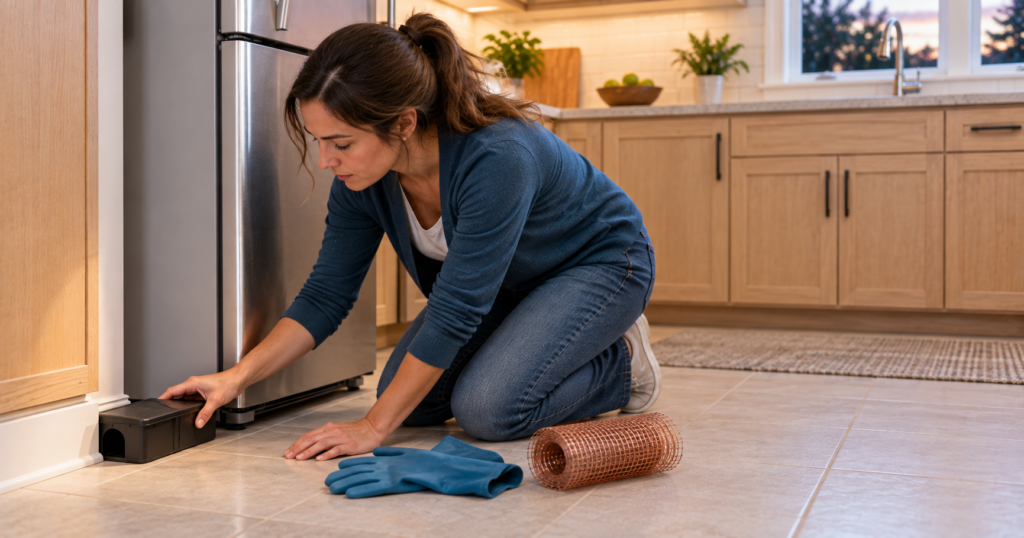
- Seal. Close roofline gaps, vents and utility entries with metal materials such as hardware cloth and steel mesh, not foam alone.
- Clean. Remove droppings and nests safely, and replace insulation where it is contaminated.
Keeping rats out of the attic
- Trim branches away from the roof. Published guidance ranges from at least 3 feet to 6 feet from the roofline, because roof rats use limbs as bridges.
- Cut back vines and ivy on walls, which roof rats climb and nest in.
- Screen vents in soffits, gables and the roof with hardware cloth.
- Guard utility lines where they meet the house.
- Pick up fallen fruit and nuts, and keep bird seed and pet food sealed.
- Close gaps of about a quarter inch or larger along the roofline and eaves.
Neighboring yards matter too. Published summaries of UC IPM guidance note that roof rats routinely travel 300 feet or more looking for food, so a rat may nest on your roof while feeding on a neighbor’s fruit tree.
DIY or professional for rats in the attic?
Reasonable DIY
- Trimming trees and vines
- Trapping a small, recent problem
- Securing food sources outside
Hire a professional
- Roofline sealing at height
- Heavy droppings or soiled insulation
- Chewed wiring (call an electrician too)
- Activity that continues after trapping
Poison is a poor choice for attic rats in DIY hands, because rats often die inside the attic or walls where you cannot reach them. If a professional uses bait, it should be in tamper-resistant stations as part of a wider plan. When comparing quotes, check that each one separates trapping, exclusion and cleanup; our guide to reading a pest control quote covers what to ask. For mice rather than rats, see our guide to a mouse in the house.
A note on source quality
Nearly every page ranking for this topic is published by a pest control or restoration company, and many advise calling that company. We have used UC Statewide IPM, a university program, for species biology and damage, and the same attributed pricing sources as our other rodent guides for costs. Where a company summarises university guidance, we say so. Pest Price Guide sells no treatment and takes no referral fees.
Our methodology
Species and damage information comes from UC Statewide IPM. Cost ranges come from Angi, This Old House, HomeGuide and a pricing publisher, labeled at the point of use and consistent with our other rodent pages. We give no rodenticide instructions. Costs vary by region, roof access and the extent of contamination, so use these ranges to judge quotes rather than as a price for your home.
Frequently asked questions
How do I know if I have rats in the attic?
Listen for scurrying and gnawing overhead at night, and look for blunt-ended droppings, tunnels or nests in insulation, gnawed wires and grease marks along beams.
Are rats in the attic roof rats or Norway rats?
Usually roof rats, which UC IPM describes as agile climbers that nest in attics and ceiling voids. Norway rats tend to stay at ground level.
How much does it cost to get rid of rats in the attic?
Angi reports an average of about $395 for rodent removal. Sealing and cleanup are usually extra, so a full job on an established infestation often costs more.
Are rats in the attic dangerous?
They can be. UC IPM notes that roof rats gnaw on wiring, which can create sparks and fire risk, and that they shred insulation for nests.
Do I need to replace my attic insulation?
Only if it is contaminated or damaged. Light, recent activity may need only spot cleanup.
Should I seal the holes right away?
No. Remove the rats first, or you will trap them inside where they die and cause odor and more damage.
Rats in the attic: final thoughts
Rats in the attic are usually roof rats that climbed in from branches, vines or utility lines. Treat them as a safety issue as well as a nuisance, because chewed wiring is a fire risk and soiled insulation affects the whole attic.
Work in order: inspect, remove, confirm, seal with metal, then clean. Budget for all three parts of the job rather than the trapping price alone, and trim the trees that gave the rats their way in.