Last updated: September 2026 · Rodent-control guidance reviewed against current CDC recommendations and university extension resources
Pest Price Guide is independent. We do not sell pest-control services or collect pest-control leads. This guide focuses on practical mouse control and prevention for U.S. homeowners.
Finding a mouse in the house does not automatically tell you how many mice are present. However, it does tell you that a rodent found food, shelter or an opening into the structure.
The most useful response is not to buy every product marketed as a mouse repellent. Instead, look for evidence, trap rodents that may still be inside, seal the openings they can use to enter and remove accessible food sources.
CDC currently recommends that basic sequence: inspect for entry points, seal openings and use traps when there is evidence of rodents.
For a mouse already inside, traditional snap traps are one of the primary tools recommended by CDC. Place them where rodent evidence occurs, especially along walls and in protected areas. At the same time, inspect and seal entry points so additional mice cannot enter. Do not rely on ultrasonic repellers as a substitute for trapping and exclusion.
Mouse in the house: what works and what does not?
Different mouse-control products solve different problems. A trap removes a rodent already inside, while structural exclusion reduces future entry. Therefore, comparing every product as though it performs the same job can be misleading.
| Method | Evidence-based role | What to know |
|---|---|---|
| Snap traps | Recommended | CDC recommends traditional snap traps for reducing rodents around the home |
| Sealing entry points | Essential prevention | Stops additional rodents from using accessible openings |
| Food and shelter reduction | Important support | Makes the property less attractive and reduces available resources |
| Glue traps | CDC says not to use | CDC specifically advises against glue traps |
| Live traps | CDC says not to use | CDC advises against live traps because frightened rodents may urinate and increase exposure risk |
| Poison / bait stations | Not CDC’s first step | CDC says poison or bait stations may be considered for persistent infestations |
| Ultrasonic devices | Do not rely on them | FTC has challenged unsupported claims that ultrasonic products eliminate or repel rodents |
| Peppermint and scent remedies | Not a substitute for control | They do not remove rodents or close structural entry points |
First, look for evidence of mice
A single sighting does not establish the size of an infestation. Fortunately, rodents usually leave other evidence.
CDC notes that signs of rodents can appear before you ever see the animal itself.
Look for:
- Droppings in drawers, cabinets or along walls
- Gnaw marks on food packages or building materials
- Shredded nesting material
- Urine spots
- Scratching or movement sounds
- Damaged stored food
If droppings are your main clue, our mouse vs. rat droppings guide can help you compare common signs. If you hear activity inside the structure, see our scratching sounds in walls guide.
CDC provides specific procedures for cleaning rodent urine, droppings and nesting material. Wet contaminated material with an appropriate disinfectant before wiping it up, and follow current CDC cleanup precautions.
Step 1: inspect how the mouse may have entered
Before placing traps randomly around the house, inspect the structure.
CDC says mice can fit through an opening about 1/4 inch wide, approximately the width of a pencil.
Inside the home, CDC recommends checking locations such as:
- Behind kitchen cabinets and appliances
- Around pipes under sinks
- Around water-heater and furnace lines
- Near floor and dryer vents
- Around electrical, water, gas and sewer lines
- Basements and crawl spaces
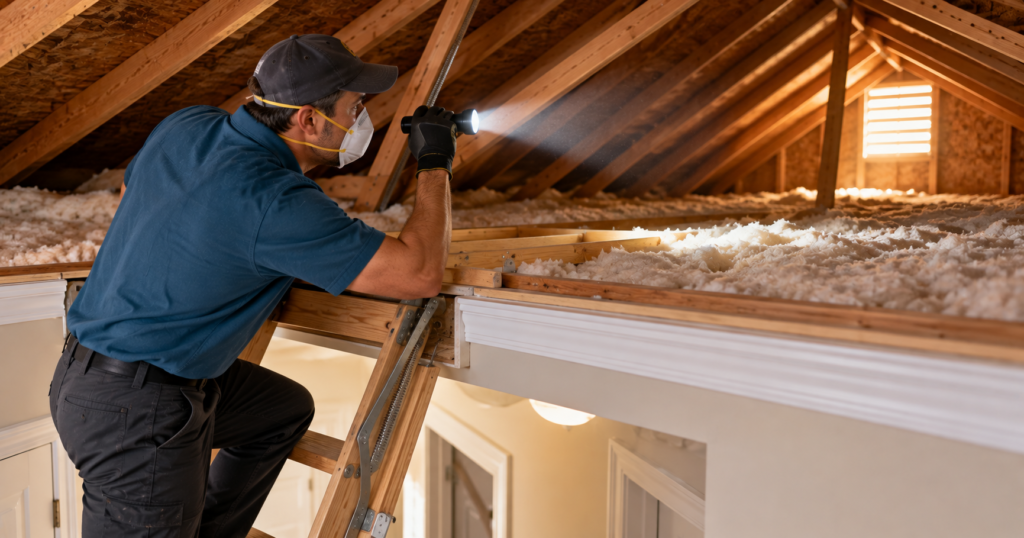
- Attics
- Floor-to-wall joints
Outside, inspect foundations, doors, windows, utility penetrations, crawl-space vents, eaves, soffits and roofline openings.
If an opening is approximately the width of a pencil, treat it as a potential mouse entry point. Smaller openings and damaged materials may still deserve repair, particularly if there is evidence of gnawing.
Step 2: use snap traps for mice that may still be inside
CDC recommends traditional snap traps when there is evidence of rodents.
Placement matters. Mice tend to travel next to walls and other objects rather than crossing exposed spaces without cover.
CDC recommends placing traps on the floor against the wall with the baited end next to the wall so that the trap forms a “T” with it.
Useful locations include:
- Behind the refrigerator
- Behind the stove
- At the back of cabinets and drawers
- Near droppings or gnaw marks
- Along walls where activity has occurred
- In basements, attics and crawl spaces where evidence exists
Always follow the trap manufacturer’s instructions and keep traps out of reach of children and pets.
How many traps should you use?
There is no universal number that works for every house.
Instead, match the number and location of traps to the evidence.
For example, one trap beside the kitchen trash can may be inadequate if droppings occur behind the stove, under the sink and in the pantry.
Conversely, a homeowner should not assume that filling every room with traps is necessary when evidence is limited to one area.
Mark every location where you find droppings, gnawing, nesting material or sightings. Concentrate traps in those areas and continue monitoring for new evidence elsewhere.
Step 3: seal mouse entry points
Trapping addresses rodents that may already be inside. Exclusion addresses the route that allowed them into the structure.
CDC recommends sealing openings as part of rodent control rather than leaving the house open until every possible mouse has been captured.
At the same time, continue trapping for rodents that may remain indoors.
Small openings
CDC recommends filling small holes with steel wool and securing it with caulk or spray foam.
Larger openings
For larger holes, CDC recommends more durable materials such as:
- Metal
- Hardware cloth
- Lath screen
- Metal sheeting
- Cement
Missouri Extension similarly identifies eliminating structural openings as the most successful permanent form of house-mouse control and recommends metal or concrete for vulnerable openings.
For a room-by-room exclusion inspection, see our fall pest-proofing checklist. If the repairs are extensive, our rodent exclusion cost guide explains professional sealing costs.
Should you use expanding foam?
The answer is more nuanced than “foam never works.”
CDC specifically lists spray foam as one option for securing steel wool in small openings.
However, materials that rodents can gnaw should not automatically be treated as durable stand-alone barriers for vulnerable larger openings.
Therefore, match the material to the size and location of the gap instead of filling every hole with exposed foam.
Step 4: remove food and shelter
Trapping and exclusion work better when mice have less access to food and nesting opportunities.
CDC recommends tightly sealing food and garbage and keeping outdoor areas clean.
Inside the home:
- Store food in tightly closed containers
- Secure pet food
- Clean crumbs and food spills
- Clean underneath appliances when accessible
- Keep garbage covered
- Reduce clutter that provides shelter
Outside, reduce accessible food and shelter near the structure, including spilled seed, garbage and unnecessary clutter.
How do you know when the mice are gone?
This is more useful than relying on a fixed number of trapping days.
CDC recommends continuing to trap until there are no more rodents. It also provides a practical monitoring benchmark: if no rodents are captured for a week and there are no new signs of rodent activity, that is evidence the rodents are gone.
Continue checking for:
- New droppings
- New gnaw marks
- New food damage
- Trap activity
- New scratching sounds
After your last capture, record the date. Continue checking traps and previously active areas. If seven days pass without another capture or fresh rodent evidence, CDC considers that a useful indication that the rodents are gone.
The Mouse Activity Map
Instead of guessing where to place traps, create a simple map of the evidence.
| Location | Droppings | Gnawing | Sighting / sound | Trap result |
|---|---|---|---|---|
| Behind stove | □ | □ | □ | _____ |
| Behind refrigerator | □ | □ | □ | _____ |
| Under sink | □ | □ | □ | _____ |
| Pantry | □ | □ | □ | _____ |
| Garage | □ | □ | □ | _____ |
| Basement / crawl space | □ | □ | □ | _____ |
| Attic | □ | □ | □ | _____ |
| Other: ______ | □ | □ | □ | _____ |
This gives you a repeatable way to decide where traps belong and whether activity is spreading or declining.
The Mouse Control Progress Tracker
Next, track evidence instead of relying on memory.
| Check | Mice caught | Fresh droppings? | New gnawing? | New sounds? |
|---|---|---|---|---|
| Day 1 | _____ | Yes / No | Yes / No | Yes / No |
| Day 3 | _____ | Yes / No | Yes / No | Yes / No |
| Day 5 | _____ | Yes / No | Yes / No | Yes / No |
| Day 7 | _____ | Yes / No | Yes / No | Yes / No |
| Day 10 | _____ | Yes / No | Yes / No | Yes / No |
| Day 14 | _____ | Yes / No | Yes / No | Yes / No |
The goal is not to reach a particular number of catches. Instead, look for the disappearance of fresh evidence after entry points have been addressed.
Do ultrasonic mouse repellers work?
Ultrasonic devices are heavily marketed because they promise an easy solution: plug in a device and make rodents leave.
However, homeowners should be skeptical of broad efficacy claims.
The Federal Trade Commission has repeatedly challenged companies over unsupported claims that ultrasonic or electromagnetic pest-control devices repel, control or eliminate rodents and other pests.
In previous FTC cases, the agency also challenged claims that these devices could replace traps, pesticides or professional pest control without adequate scientific substantiation.
Do not use an ultrasonic device as a substitute for inspecting entry points, sealing the structure and trapping mice already inside. Those actions directly address the infestation and its entry route.
What about peppermint oil?
Peppermint oil is frequently promoted online as a natural mouse repellent.
However, even if an odor temporarily affects rodent behavior, scent does not physically close a 1/4-inch opening or remove a mouse already established inside the structure.
Therefore, Pest Price Guide does not count peppermint oil as a primary mouse-control method.
If you choose to use a scent product, it should not replace trapping, monitoring and exclusion.
What about mothballs?
Mothballs should not be scattered around a home as a DIY mouse treatment.
Mothballs are pesticide products with labeled uses and should only be used according to their label.
Using a pesticide product in a manner inconsistent with its labeling can create unnecessary exposure without solving the structural conditions that allowed mice into the house.
Should you use glue traps?
CDC specifically advises against glue traps for home rodent control.
Its concern is not simply whether the trap can catch a mouse. CDC notes that trapped rodents can become frightened and urinate, which can increase the risk of exposure to rodent urine.
For home trapping, CDC recommends appropriately sized traditional snap traps instead.
Should you use live traps?
CDC also advises against live traps for the same exposure concern.
In addition, catching a mouse alive does not solve the structural opening that allowed it to enter.
For those reasons, this guide prioritizes snap trapping plus exclusion rather than catch-and-release.
What about mouse poison?
The original version of this article treated indoor poison as something homeowners should never use. Current CDC guidance is more nuanced.
CDC recommends snap traps as the initial trapping method and says poison or bait stations may be considered when mouse or rat infestations persist.
Poison baits can be dangerous to people and animals, so any pesticide product must be used exactly according to its label and kept inaccessible to children and pets.
If trapping and exclusion are not resolving the problem, professional assessment may be more useful than improvising with additional products.
DIY mouse control vs. professional rodent control
There is no reliable rule saying that seeing one mouse is DIY while seeing three means you need an exterminator.
Instead, base the decision on whether you can locate the activity, access the entry points and demonstrate that the evidence is declining.
| Situation | DIY may be reasonable | Professional help may be useful |
|---|---|---|
| Evidence confined to one accessible area | Yes | If activity persists |
| Accessible entry points | Often | If structural repair is difficult |
| Activity in several rooms | Possible | Broader inspection may help |
| Attic or crawl-space activity | Depends on safe access | Often useful |
| Repeated captures despite exclusion work | Reassess first | Professional inspection may identify missed entry points |
| Uncertain whether the animal is a mouse or rat | Identification first | Useful when evidence is unclear |
For current pricing, see our rodent control cost guide. If the main expense is structural sealing rather than trapping, see our rodent exclusion cost guide.
What should a professional mouse-control quote include?
Do not compare rodent companies only by total price.
Ask what the quote actually includes:
- Interior and exterior inspection
- Species identification
- Trap placement and follow-up
- Number of included visits
- Entry points documented
- Minor sealing vs. full exclusion
- Attic or crawl-space inspection
- Dropping or nesting-material cleanup
- Warranty or callback terms
- Excluded structural repairs
Rodent removal, exclusion and contamination cleanup are different scopes of work. A low trapping quote is not necessarily cheaper if structural sealing and cleanup will later be billed separately.
The Mouse Control Cost Worksheet
Use this worksheet when comparing DIY expenses with a professional proposal.
| Cost item | DIY | Professional quote |
|---|---|---|
| Inspection | $_____ | $_____ |
| Traps / removal | $_____ | $_____ |
| Follow-up visits | $_____ | $_____ |
| Entry-point sealing | $_____ | $_____ |
| Door / vent repairs | $_____ | $_____ |
| Cleanup | $_____ | $_____ |
| Attic work | $_____ | $_____ |
| Total | $_____ | $_____ |
This makes it harder to compare a $30 DIY trapping setup with a $600 professional proposal when the professional price also includes exclusion and follow-up work.
How to clean up after mice safely
Rodent cleanup deserves its own precautions.
CDC advises against sweeping or vacuuming dry rodent urine, droppings or nesting material because contaminated particles can become airborne.
Instead, follow current CDC cleanup guidance, which includes using gloves, thoroughly wetting contaminated material with disinfectant and wiping it up.
For heavy infestations or extensive contamination in attics, crawl spaces or HVAC-related areas, additional precautions may be appropriate.
How to keep mice from coming back
After activity stops, keep the exclusion work in place.
- Recheck utility penetrations
- Inspect exterior doors and garage seals
- Repair damaged vent screens
- Keep food and pet food secured
- Reduce outdoor food sources near the home
- Watch previously active areas for fresh droppings
- Inspect new structural gaps after repairs or remodeling
Our fall pest-proofing checklist provides a repeatable perimeter inspection that can be used even outside the fall season.
Our methodology
This guide prioritizes government and university-extension recommendations over product marketing.
For home trapping, entry-point inspection, exclusion and cleanup, we use current CDC rodent-control guidance.
CDC recommends traditional snap traps, advises against glue and live traps, and says poison or bait stations may be considered when infestations persist.
For structural exclusion, we also use University of Missouri Extension guidance, which describes eliminating openings as the most successful permanent form of house-mouse control.
For ultrasonic devices, we rely on the Federal Trade Commission’s documented enforcement history involving unsupported rodent- and pest-repellent claims rather than claims made by companies selling either the devices or competing pest-control services.
Finally, the Mouse Activity Map, 7-Day Evidence Check, Mouse Control Progress Tracker and Cost Worksheet are Pest Price Guide tools designed to turn those recommendations into a repeatable homeowner process.
Frequently asked questions
If I see one mouse, does that mean there are more?
Not necessarily. One sighting cannot tell you the population size. Instead, inspect for droppings, gnaw marks, nesting material and other activity, then monitor traps to determine whether additional mice are present.
What is the best way to get rid of mice in the house?
CDC recommends traditional snap traps for rodents already inside, combined with finding and sealing openings that allow rodents to enter. Reducing accessible food and shelter also supports control.
What size hole can a mouse fit through?
CDC says mice can fit through an opening about 1/4 inch wide, approximately the width of a pencil.
Do ultrasonic mouse repellers work?
Do not rely on them to eliminate an infestation. The FTC has repeatedly challenged unsupported efficacy claims involving ultrasonic and electromagnetic pest-control devices. Trapping and exclusion directly address mice already inside and their entry routes.
Does peppermint oil get rid of mice?
Peppermint oil does not remove mice already inside or close their entry points. Even if a scent temporarily changes rodent behavior, it should not replace trapping, monitoring and structural exclusion.
Should I use glue traps?
CDC advises against glue traps. For home rodent control, it recommends appropriately sized traditional snap traps.
Should I use mouse poison indoors?
CDC recommends starting with snap traps and says poison or bait stations may be considered when an infestation persists. Any pesticide product must be used according to its label and kept away from children and pets.
How do I know when the mice are gone?
Continue monitoring after the last capture. CDC says that if no rodents are captured for a week and there are no new signs of rodent activity, that is an indication the rodents are gone.
Final thoughts
A mouse in the house is easier to solve when you separate the problem into three jobs.
First, determine where the activity is occurring and trap mice that may remain inside. Second, find and seal the openings they can use to enter. Third, remove accessible food and shelter that make the property attractive.
Meanwhile, track fresh evidence. New droppings, gnawing and trap captures tell you more than simply counting the days since you last saw a mouse.
Finally, do not let an easy-looking product distract you from those fundamentals. Ultrasonic devices and scent remedies do not physically remove a mouse or repair a pencil-width opening.
If activity continues despite trapping and exclusion, or if entry points are inaccessible, a professional inspection can help identify what the DIY approach has missed.