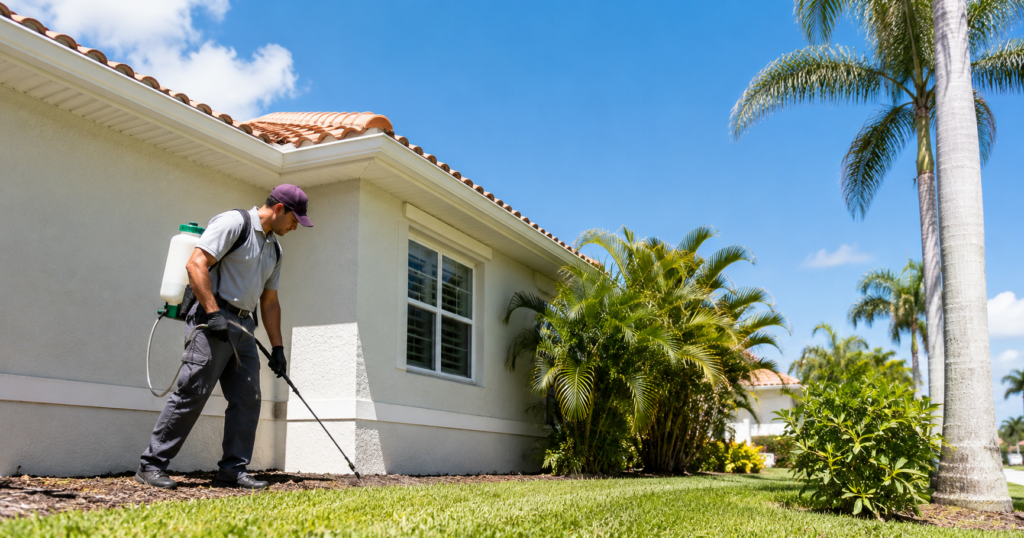
Texas pest control cost averages $138 in Houston and $152 in Dallas, according to Angi data. Those figures sit within ranges of $85 to $191 and $88 to $216 respectively.
Texas is unusual for two reasons that show up directly on quotes.
Scorpions are the first. Central Texas homeowners face a line item that barely exists elsewhere in the country.
Formosan termites are the second. Published sources describe them as chewing structural lumber five to ten times faster than native subterranean species.
Consequently, Texas quotes contain items a national pricing guide will not prepare you for.
There is also a legal dimension worth knowing. The Texas Department of Agriculture publishes consumer protections that most homeowners never read, including a specific cancellation right.
We cover those below, alongside metro pricing, species-specific costs and the construction details that move a quote.
Every source is named, and commercial interests are flagged, including our own.
Texas Pest Control Cost at a Glance
Here is what published sources report for Texas specifically.
| Service | Published figure | Source |
|---|---|---|
| Houston average | $138, range $85–$191 | Angi |
| Dallas average | $152, range $88–$216 | Angi |
| Full-service job, 1,500 sq ft | $300–$550 | Angi, Dallas |
| Annual spend | $300–$800 | Texas operator* |
| Quarterly, DFW | $90–$165 per visit | Texas operator* |
| Quarterly, Austin | $85–$155 per visit | Texas operator* |
| Quarterly, San Antonio | $80–$150 per visit | Texas operator* |
| Monthly recurring | $40–$70 per visit | Texas operator* |
| Scorpion treatment | Adds $50–$100 | Texas operator* |
| Termite fumigation, severe | Up to $8,000 | Angi, Dallas |
*Sources marked with an asterisk are Texas pest control companies publishing their own pricing guides. They know the market well, though they sell what they price.
Notably, the Angi averages sit at the lower end of operator ranges. That gap is normal, since aggregator data includes simpler jobs that operators quote separately.
Meanwhile, the fumigation figure is the outlier. Angi’s Dallas page reports severe termite fumigation reaching $8,000 or more.
Simple trap-based work, by contrast, can run around $100 according to the same source.
For national benchmarks, see our pest control cost hub.
Texas Pest Control Cost by Metro
Texas pest control cost varies more between metros than in most states, because Texas spans several climate zones.
| Metro | Reported per-visit range | Primary pressures |
|---|---|---|
| Houston | $140–$230 | Formosan termites, mosquitoes, German roaches |
| Dallas | $110–$190 | Fire ants, subterranean termites, brown recluse |
| Austin | $115–$200 | Scorpions in Hill Country |
| San Antonio | $105–$185 | Mosquitoes, scorpions in northwest corridor |
| Fort Worth | $100–$180 | Rodents and roaches in older east side |
| Corpus Christi | $130–$220 | Coastal humidity, mosquitoes |
| El Paso | $90–$160 | Scorpions, roof rats, lower humidity |
Notably, these metro figures come from a pricing site that earns revenue through lead referral. We include them because the pest-pressure descriptions are specific and useful.
However, we flag a problem with that source in the next section.
Notably, El Paso sits lowest and Houston highest. Humidity explains most of that spread.
Meanwhile, Angi’s own city averages tell a similar story with different numbers. Houston at $138 and Dallas at $152 both fall below the operator ranges above.
Consequently, treat metro figures as directional rather than precise. Gather three local quotes regardless of what any table says.
Why Published Texas City Prices Conflict
We flagged this pattern in our Florida pest control cost guide, and Texas shows it more starkly.
One widely ranking pricing site states that Houston prices sit above the national average because of year-round pest pressure and high termite risk. Its own disclaimer on the same page states that ranges are estimated based on national averages.
Those two statements cannot both be true. A figure derived from a national average cannot simultaneously demonstrate a local premium.
We are not naming the publisher, since the pattern matters more than the accusation. It appears across multiple city pages.
Meanwhile, genuinely local data exists. Angi publishes city pages built from member-reported jobs, which is why we lead with its Houston and Dallas figures.
That difference in method explains the numeric gap. Angi reports Houston at $138, whereas the estimated source reports about $195.
So apply one test to any local pricing page you read. Find the methodology note and check whether the figures are locally sourced or nationally derived.
That test applies to this page too. Every figure here states its origin.
Texas Pest Control Cost: The Scorpion Line Item
Notably, scorpions are the clearest cost that national guides simply do not cover.
Specifically, the striped bark scorpion is common across Central Texas and the Hill Country. Published guidance identifies limestone karst formations in Travis, Hays, Comal and Williamson counties as providing abundant harborage.
Furthermore, flagstone, expansion joints and dry-stack retaining walls all shelter them. That construction style is common in exactly those counties.
Consequently, treatment requires targeted work rather than a standard exterior barrier spray. A Texas operator reports scorpions adding $50 to $100 to a standard service package.
Meanwhile, frequency changes too. Published commentary describes Austin and San Antonio companies pricing monthly service higher because monthly is genuinely necessary.
The reasoning is specific. Quarterly service leaves roughly an eight-week gap, which allows populations to rebuild.
Meanwhile, another source reports treatments at $150 to $350, often bundled into DFW general plans.
Notably, scorpions appear in newer suburban developments where construction disturbed natural habitat. Frisco, McKinney, Prosper and Celina are named in published guidance.
So ask specifically whether scorpions are covered before signing. This is the single most common Texas exclusion.
Texas Pest Control Cost for Termites
Termites drive the largest single Texas pest control cost decision most homeowners face.
Notably, published Texas figures vary considerably. One operator reports treatment between $290 and $1,150, with roughly $500 average for liquid perimeter work on a 2,500 square foot home.
Another reports Formosan liquid barrier treatment at $800 to $1,500, with Sentricon bait systems at $1,200 to $2,500 plus ongoing monitoring.
Angi’s Dallas page reports severe infestations requiring tent fumigation reaching $8,000 or more.
That spread reflects method and species rather than inconsistency. Spot work, perimeter barriers and whole-structure fumigation are different projects.
Meanwhile, published commentary places Texas second only to Florida in national termite pressure.
Furthermore, damage repair sits outside treatment pricing entirely. One Texas operator reports repair frequently reaching $3,000 or more.
Standard homeowners policies generally exclude termite damage as preventable maintenance. Both treatment and repair therefore come out of pocket.
Our termite treatment cost guide covers method pricing in national detail.
Formosan Termites on the Gulf Coast
One invasive species reshapes Texas pest control cost along the Gulf Coast.
Published sources report Formosan subterranean termites first confirmed in Harris County in 1965. They have expanded across the Gulf Coast since.
Specifically, two behaviors make them more expensive than native species.
First, they build aerial carton nests inside walls. That means a colony can survive without soil contact, which defeats treatments designed around ground-based access.
Second, published guidance describes them consuming structural lumber five to ten times faster than native eastern subterranean termites.
Consequently, treatment usually combines methods rather than relying on a single barrier. Cost rises accordingly.
Notably, Houston-specific figures reflect that. Published guidance puts Houston termite treatment at $1,500 to $4,500 for a typical home, above national ranges.
Meanwhile, detection matters more here than elsewhere. Aerial nests produce different evidence than ground colonies do.
So if you are on the Gulf Coast, ask any inspector specifically about Formosan activity. Species identification changes the treatment plan entirely.
Finally, annual inspection is standard in this zone rather than an upsell.
Texas Pest Control Cost: Fire Ant Exclusions
Generally, fire ants are near-universal across Texas, though they carry a contractual catch.
Texas A&M AgriLife Extension guidance, as reported by a commercial publisher, describes fire ant colonies containing between 200,000 and 500,000 workers.
Notably, that scale explains why DIY treatment frequently fails. Killing visible workers leaves the queen and satellite colonies intact.
Published guidance identifies fire ants as the single most persistent pest across DFW yards. Most Texas companies include treatment in standard packages as a result.
Still, here is the catch worth knowing before signing.
Published guarantee terms commonly exclude fire ant reinfestation from neighboring properties. The reasoning is that colonies continuously migrate across property lines.
Consequently, your guarantee may cover treatment without covering recurrence. That distinction rarely appears in a sales conversation.
Meanwhile, professional baiting programs address colonies rather than surface activity. That is the treatment approach published extension guidance supports.
So ask two questions. Is fire ant treatment included, and does the guarantee cover reinfestation?
Our guide to reading a pest control quote covers the exclusion language to check.
How Construction Affects Texas Pest Control Cost
Two building details specific to Texas move pricing, and neither appears in national guides.
Brick with weep holes. Published guidance notes that brick homes throughout DFW require weep hole screening to prevent cockroach and pest entry.
Specifically, those gaps at the base of brick veneer allow drainage by design. They also provide direct access into wall cavities.
Notably, screening them is exclusion work rather than spraying. Ask whether it is included or quoted separately.
Pier-and-beam foundations. Generally, older Texas neighborhoods use them, which creates accessible crawl spaces for rodents and termites.
Consequently, inspection takes longer and access work costs more than on slab construction.
Meanwhile, newer suburban construction creates different problems. Published guidance links scorpion pressure to developments where building disturbed natural habitat.
Furthermore, clay-heavy Gulf Coast soils affect drainage and moisture, which affects termite pressure.
Notably, homes near wooded creeks face elevated rodent pressure. White Rock Creek, Turtle Creek and Five Mile Creek appear in published Dallas guidance.
Our rodent control cost guide covers how exclusion pricing works.
Texas Pest Control Cost and Your Legal Rights
Texas publishes consumer protections that most homeowners never see, and two are directly actionable.
Specifically, the Texas Department of Agriculture provides consumer guidance for structural pest control. Its Structural Pest Control Service handles suspected violations.
Cancellation. That guidance states consumers who contract for pest control due to a home solicitation have the right to cancel within 72 hours. Notification to the company exercises that right.
Posted notice. The same guidance addresses advance notice. In many instances, signs must appear in an area of common access at least 48 hours before treatment.
Label compliance. Texas guidance also states that application procedures specified on the pesticide label must be followed by law.
That last point defeats a common upsell. A company cannot legally apply more product than the label permits, which means premium chemical packages at higher rates are not a real product tier.
Consequently, ask which product and at what rate. Then compare against the standard package.
Meanwhile, these protections apply to solicited sales specifically. A contract you initiated by calling is treated differently.
Nothing here is legal advice, and statutes change. Verify current requirements with the state agency.
Verifying a Texas Company
Before accepting any Texas pest control cost quote, verify the license. It takes minutes.
Texas regulates structural pest control through its Department of Agriculture. Any company treating your home should hold current state licensing.
Consequently, ask for the license number and check it against the state database before signing.
Then ask three further questions specific to Texas.
Does the plan cover scorpions? Does the guarantee cover fire ant reinfestation? Have you identified the termite species, and is it Formosan?
Those three answers separate a Texas-appropriate quote from a generic one.
Meanwhile, gather three written proposals rather than accepting the first. Texas has a large provider base, which gives real negotiating leverage.
Notably, published Texas ranges vary by roughly 100 percent between metros. A quote far outside your metro’s range deserves questions.
Our free pest inspection guide covers how to use diagnosis visits without pressure.
Then read each proposal against the nine line items in our quote reading guide.
Texas Pest Control Cost: Monthly Versus Quarterly
Frequency is where Texas diverges most from national norms, though the answer is regional.
Published guidance describes quarterly as the most common service structure in Texas. Reported quarterly pricing runs $80 to $200 per visit depending on metro.
Monthly recurring plans run $40 to $70 per visit, per a Texas operator. That is lower per visit but higher annually.
Overall, two situations genuinely justify monthly service in Texas.
Hill Country scorpion pressure. Published commentary explains that quarterly leaves an eight-week gap allowing populations to rebuild.
German cockroach infestations. Published Texas figures put initial treatment at $200 to $500, followed by monthly visits at $80 to $120 for three to six months.
Otherwise, quarterly remains the standard recommendation. Published guidance describes peak pressure from March through November with year-round activity.
Consequently, run the annual arithmetic rather than comparing per-visit rates.
Our quarterly pest control guide works through the breakeven math.
If you have a written Texas quote, submit it to our pricing research.
A Note on Source Quality
Texas pest control cost content divides into three categories with different reliability.
Home-services aggregators such as Angi publish city data from member-reported jobs. They earn revenue through lead referral, though the geographic basis is genuine.
Texas pest control operators publish their own state guides. Those carry real local knowledge about scorpions, Formosan termites and construction details, and they sell what they price.
Lead-referral pricing sites publish city pages at scale. As covered earlier, at least one discloses that its ranges derive from national averages while claiming local premiums.
We have used the first category for headline figures, flagged the second at each citation, and excluded the third from our lead numbers.
Meanwhile, one extension citation here is secondhand. The Texas A&M AgriLife fire ant colony figure reached us through a commercial publisher rather than the extension page.
We flag that chain rather than presenting it as primary research.
Regulatory information comes from Texas Department of Agriculture consumer guidance, which is an official state source.
This page has a commercial interest too. Referral revenue arises when readers connect with providers, disclosed where it occurs.
Our Methodology
We operate no proprietary quote database, and we publish no invented averages.
Every figure above comes from a published source, named or categorized at the point of use.
City averages come from Angi’s Houston and Dallas pricing pages. Metro ranges and species detail come from Texas pest control operators and a lead-referral pricing site, labeled as such.
Regulatory information draws on Texas Department of Agriculture consumer guidance for structural pest control.
The Texas A&M AgriLife fire ant figure reached us through a commercial publisher citing that extension. Verify with the extension source before relying on it.
We do not blend figures from different sources into a single statewide average. Where sources conflict, as they do on Houston pricing, we show both and explain the methodological difference.
We accept no payment from pest control companies for placement, ranking or favorable coverage. Referral revenue is disclosed on the pages where it occurs.
Nothing here is legal advice. Statutory requirements change and vary, so verify with the state agency.
This page is reviewed every six months, with the update date shown at the top.
Frequently Asked Questions
What is the average Texas pest control cost?
Angi reports $138 average in Houston and $152 in Dallas. Texas operators report annual spending between $300 and $800.
How much extra do scorpions cost to treat?
A Texas operator reports scorpions adding $50 to $100 to a standard package. Another reports standalone treatments at $150 to $350.
Why is Houston more expensive than El Paso?
Humidity and Formosan termite pressure. Published metro ranges put Houston at $140 to $230 per visit versus El Paso at $90 to $160.
Are fire ants covered by my guarantee?
Often not for reinfestation. Published guarantee terms commonly exclude fire ants migrating from neighboring properties.
Can I cancel a Texas pest control contract?
Texas Department of Agriculture guidance describes a 72-hour cancellation right for contracts arising from home solicitation.
Do I need monthly service in Texas?
Only for scorpion pressure in the Hill Country or an active German cockroach infestation. Quarterly is the standard elsewhere.
What makes Formosan termites more expensive?
Published sources describe them building aerial nests inside walls and consuming lumber five to ten times faster than native species.
Final Thoughts
Texas pest control cost is best judged by metro rather than by state, since ranges vary by roughly 100 percent across the state.
Angi puts Houston at $138 average and Dallas at $152. Operator quarterly pricing runs $80 to $200 per visit depending on where you live.
Two line items deserve specific attention before you sign. Ask whether scorpions are covered, and ask whether the fire ant guarantee includes reinfestation.
Meanwhile, treat termites as a separate and larger decision. Gulf Coast homeowners facing Formosan activity should expect quotes well above national ranges.
Finally, know your cancellation rights. Texas guidance describes a 72-hour window for contracts arising from door-to-door solicitation, which is worth remembering when someone knocks.
Gather three written quotes, check the license number, and compare annual totals rather than per-visit rates.